
Science & STEM Programs
Hands-on learning that inspires curiosity, innovation, and problem-solving.
Our Science & STEM programs are designed to introduce students to the fundamentals of science, technology, engineering, and mathematics through hands-on learning and real-world applications.
We encourage curiosity, experimentation, and creative thinking while maintaining a structured and safe learning environment.
Physics
Students explore how the world works through motion, forces, and energy — always through experiments, not memorization.
Topics include:
Forces and motion
Magnets and electricity
Simple machines
Light, sound, and energy
Skills developed:
Logical thinking
Cause-and-effect understanding
Problem-solving through experimentation


Science for Grades 2–6
Our integrated science program introduces students to the fundamentals of biology, chemistry, physics, and environmental science through age-appropriate experiments and projects.
What students learn:
Scientific observation and inquiry
Asking questions and forming hypotheses
Recording results and drawing conclusions
Understanding how science connects to everyday life
Format:
Hands-on experiments, discussions, models, and simple lab work.
Online Science for Beginners
Start Exploring Biology & Chemistry from the Basics
Our new Online Science for Beginners class is designed for students who are ready to begin exploring biology and chemistry from the ground up.
No previous science background is required. Students will build a strong foundation step by step, learning important scientific concepts in a clear, engaging, and age-appropriate way.
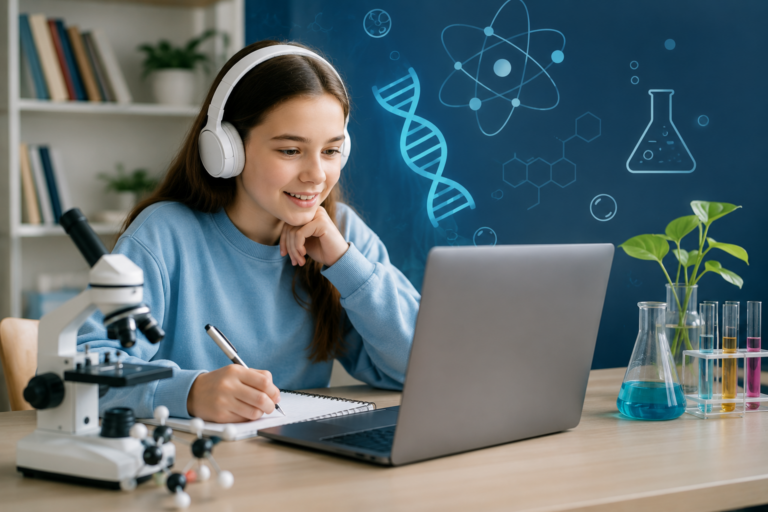
What Students Will Explore
Fundamentals of biology and chemistry
Living organisms and how they function
Cells, plants, animals, and the human body
Matter and its properties
Simple chemical processes and reactions
Scientific observation and reasoning
How science connects to everyday life
Designed for Beginners
Lessons are structured specifically for students who are new to biology and chemistry. Complex ideas are introduced gradually through clear explanations, visual examples, discussions, and interactive activities.
Students are encouraged to ask questions, think independently, and develop genuine curiosity about the world around them.
Online Learning
Classes take place online, allowing students to join from anywhere while learning together in an interactive group environment.
Our goal is not simply to memorize scientific facts, but to help students understand how science works, build confidence, and create a strong foundation for further study in biology and chemistry.
Biology
Biology classes help students understand living systems — from plants and animals to the human body.
Topics include:
Human body systems
Plants and ecosystems
Animals and habitats
Microscopic life (introductory level)
Learning approach:
Observation, models, drawings, experiments, and real-world examples.


Chemistry
Our chemistry program introduces students to the basics of chemical reactions in a safe and engaging environment.
Topics include:
States of matter
Mixing and reactions
Acids and bases (introductory level)
Laboratory safety and procedures
Focus:
Curiosity, experimentation, and understanding processes — not formulas.
Robotics
Robotics classes combine science, engineering, and teamwork.
Students learn:
How simple robots work
Sensors and movement
Basic engineering concepts
Team collaboration and problem-solving
Format:
Hands-on building, testing, and improving robotic models.


Coding
Coding classes introduce students to programming logic in an accessible and age-appropriate way.
Topics include:
Block-based and beginner coding
Algorithms and sequencing
Logical thinking
Debugging and problem-solving